

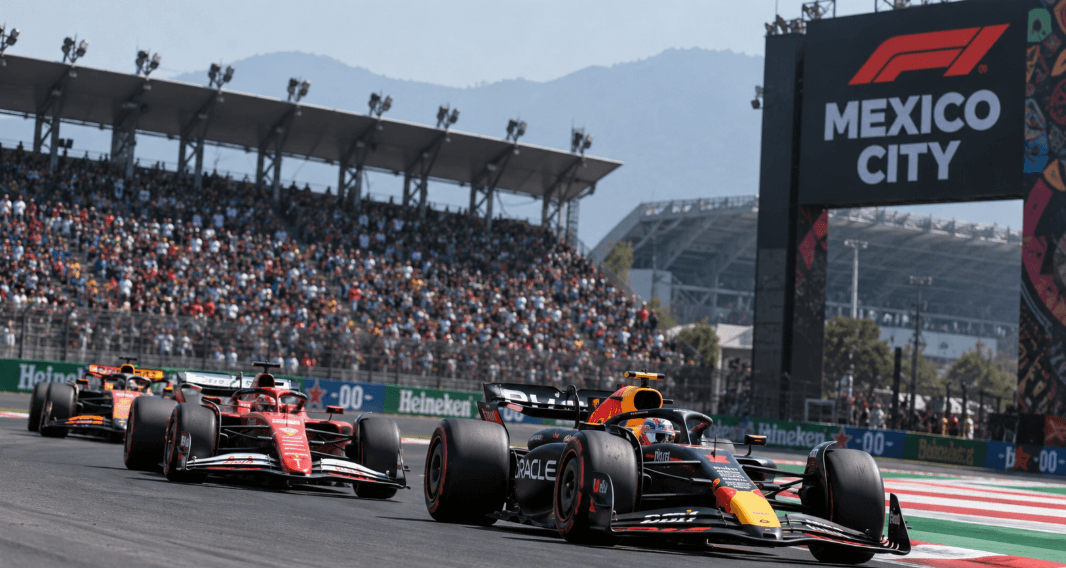
Formula 1 teams face a demanding weekend at the 2026 Mexico City Grand Prix, where high altitude, revised engine regulations and reduced aerodynamic downforce could significantly influence performance. The race also follows a controversial United States Grand Prix in Austin, with Red Bull reviewing strategic mistakes and several drivers addressing ongoing disputes.
Mexico City’s Altitude Creates Major Challenges for 2026 F1 Engines
The Mexico City Grand Prix presents a particularly difficult test for Formula 1’s new power units, which no longer feature the Motor Generator Unit-Heat (MGU-H).
At high altitude, thinner air forces turbochargers to operate at higher speeds to generate sufficient boost pressure. Without the MGU-H, manufacturers face additional difficulties managing turbo lag.
Honda trackside engineering chief Shintaro Orihara described the situation as “quite challenging.”
“Last year we had MGU-H, so we have some support from MGU-H, but this year we don’t have MGU-H, so it’s quite challenging,” Orihara said.
Honda has completed extensive dynamometer testing but will need practice sessions to confirm whether operating restrictions are necessary.
Battery Management Adds Another Complication
The circuit’s three long straights place significant demands on battery deployment.
Teams must balance electrical energy used for acceleration against energy needed to compensate for turbo lag in slower corners.
The MGU-K can help maintain turbocharger performance by absorbing excess engine power. However, when batteries approach full capacity, this process becomes less effective.
Audi could face additional difficulties because of its larger turbocharger, although reduced aerodynamic drag may partially offset the disadvantage.
Driver Gabriel Bortoleto acknowledged the challenge.
“It’s not going to be easy for us,” he said.
Reduced Downforce Could Reshape the Mexican Grand Prix
Formula 1’s 2026 aerodynamic regulations have made Mexico City’s unusual conditions even more significant.
McLaren driver Oscar Piastri suggested the circuit has become a unique challenge compared with other tracks.
“So, it’s going to be pretty challenging. It’s probably not going to feel amazing in the car,” Piastri said.
Max Verstappen also expects reduced aerodynamic grip to make slower corners especially difficult.
Ferrari’s Lewis Hamilton estimated that cars could produce “25 or 30% less downforce than the last time we drove here”.
Ferrari could benefit from its smaller turbocharger, although tire performance remains an important uncertainty.
Sergio Perez Delights Mexico City Fans in Cadillac Demonstration
Sergio Perez entertained approximately 50,000 spectators during a demonstration run through Mexico City ahead of his home Grand Prix.
Because Cadillac does not have an older Formula 1 car available, the team borrowed a modified Formula 2 vehicle used in Apple’s F1 movie starring Brad Pitt.
Perez praised the vehicle’s cooling performance, which allowed repeated donuts without the overheating concerns commonly associated with demonstration events.
“People were super happy, and that was the biggest thing, to see the people enjoying it so much. It was a very special moment,” Perez said.
Red Bull Reviews Strategy Mistakes Following United States Grand Prix
Red Bull drivers Max Verstappen and Isack Hadjar remain concerned about the team’s performance following a disappointing race at Circuit of the Americas in Austin, Texas.
Despite starting second and third, Verstappen finished third while Hadjar placed sixth.
Poor starts, slow pit stops, communication problems and questionable strategic decisions contributed to the results.
Drivers Call for Better Race Decisions
Verstappen emphasized the importance of reviewing the team’s mistakes.
“We just need to try and understand of course how it happened, why it happened, and of course then learn from the strategy,” he said.
Hadjar also questioned Red Bull’s decision not to place both drivers on a one-stop strategy, suggesting the team could have approached its race planning differently.
Fernando Alonso’s Criticism Draws Opposition
Fernando Alonso continued criticizing driving standards following his first-lap collision with Williams driver Alex Albon at the United States Grand Prix.
However, several competitors rejected the suggestion that drivers toward the back of the field lack ability.
Albon defended the quality of competition, while Carlos Sainz pointed to turbulent airflow, closely grouped cars and greater risk-taking.
Alpine’s Pierre Gasly argued that overall driving standards have improved considerably.
“I’ve seen some wilder driving approaches when I joined compared to what I see now,” Gasly said.
Audi Strengthens Formula 1 Engine Program With Thomas Fuhr
Audi has appointed former Mercedes Formula 1 engine executive Thomas Fuhr as CEO of its power unit operation in Neuburg, Germany.
Fuhr previously helped establish the foundations for Mercedes’ successful transition to the 2014 hybrid engine regulations.
Although his arrival is unlikely to transform Audi’s immediate competitiveness, the appointment could strengthen its longer-term development strategy.
Bortoleto welcomed the leadership addition, describing Fuhr’s experience as valuable for the manufacturer’s future.
Esteban Ocon Frustrated Despite Strong Race Starts
Haas driver Esteban Ocon believes his team’s impressive starting performance has been undermined by insufficient race pace and tire management.
Ocon said his preparation and technical contributions have helped Haas improve its launches and opening-lap performance.
However, the team has struggled to maintain positions throughout races.
“It’s nice to do the show in the beginning and being in front, but we can’t hold it. And that’s what we need to work on,” Ocon said.
His uncertain Formula 1 future adds further pressure heading into the closing stages of the season.
Mexico City Grand Prix Presents Crucial Test for F1 Teams
The 2026 Mexico City Grand Prix will test how effectively teams have adapted to Formula 1’s new engine and aerodynamic regulations. Turbocharger efficiency, battery deployment, tire management and low-speed handling could determine competitiveness, while Red Bull, Audi and Haas face additional pressure to address weaknesses exposed earlier in the season.