

:quality(85)/cloudfront-us-east-1.images.arcpublishing.com/infobae/FZ3Z54GP6VCFNKOQQF33ZKTUOM.jpg 420w)
Madrid, 13 (European Press)
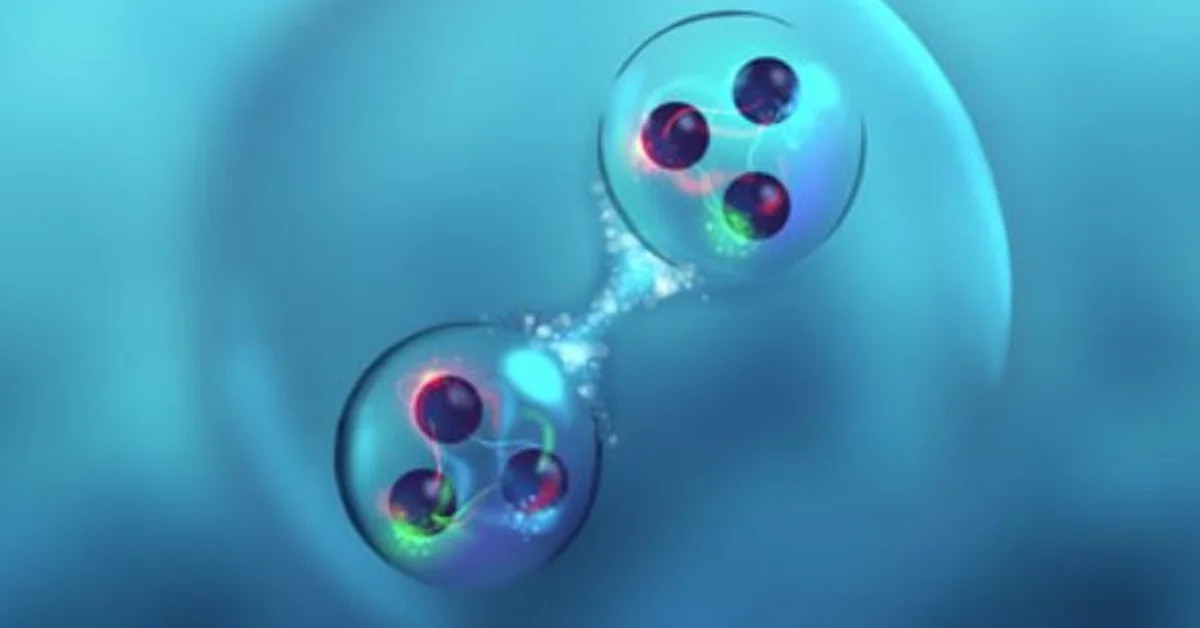
The combined use of two supercomputers by the RIKEN researchers predicted the existence of a strange particle made up of six elementary particles known as quarks.
Quarks are the basic building blocks of matter. The nuclei of atoms are made up of protons and neutrons, which in turn are made up of three quarks each. Particles made of three quarks are collectively known as baryons.
Scientists have long thought about the existence of systems containing two baryons, known as dibarions. There is only one debarion in nature: the deuteron, which is a hydrogen nucleus made up of a proton and a neutron loosely bound together. Flashes of other dibarions were detected in nuclear physics experiments, but they had a very fast stockpile.
“Although the deuteron is the only known stable deuterion, there may be more,” Takuya Sugiura of RIKEN’s Interdisciplinary Program for Mathematical and Theoretical Sciences says in a statement. “It is important to study which pairs of baryons form debarons and which do not, because this provides valuable information about how quarks are formed.”
Quantum chromodynamics is a very successful theory that describes how quarks interact with each other. But the strong coupling that occurs between quarks in baryons complicates quantum dynamic calculations. The calculations become more complex when considering the bound states of baryons such as dibarions.
Now, by calculating the force acting between two baryons, each containing three charm quarks (one of the six types of quarks), Sugiura and colleagues predicted the existence of an omega diome they called de-omega charms.
For this computation, the team solved quantum chromodynamics with large-scale numerical computations. Since the calculations included a large number of variables, they used two powerful supercomputers: the K supercomputer and the HOKUSAI supercomputer. “We were very fortunate to have access to supercomputers, which greatly reduced the cost and time to perform the calculations,” Sugiura says. “But it took us several years to predict the existence of the magic of de Omega.”
Despite the complexity of the calculations, di-Omega magic is the simplest system for studying interactions between baryons. Sugiura and his team are now studying other enchanted hadrons using the Fugaku supercomputer, the most powerful successor to the K computer. “We are particularly interested in interactions between other particles that contain enchanted quarks,” Sugiura says. “We hope to shed light on the mystery of how quarks combine to make particles and what kinds of particles they can exist.”
The research has been published in the journal Physical Review Letters.