

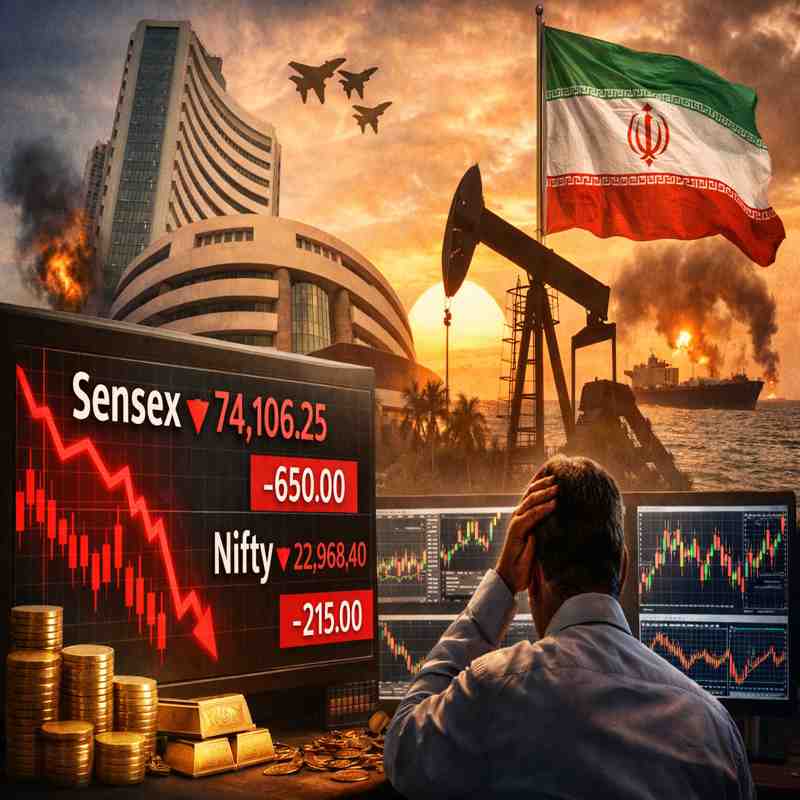
Indian equities began Tuesday’s trading session on a weak note, reflecting heightened global uncertainty after the United States and Iran failed to reach a ceasefire agreement. The geopolitical standoff has intensified concerns over energy prices and supply chains, weighing on investor sentiment across global markets.
At the opening bell, the BSE Sensex dropped by 650 points, while the NSE Nifty50 declined by 215 points. Earlier संकेत from GIFT Nifty had already pointed to a negative start, as crude oil prices remained elevated due to escalating tensions in the Middle East.
Global Risks Weigh on Market Sentiment
Iran rejected a US-backed ceasefire proposal, instead submitting a ten-point response calling for a permanent end to the conflict. The ongoing situation has disrupted global supply chains and contributed to sustained volatility in commodity markets.
Even in the event of a swift resolution, the International Monetary Fund (IMF) is expected to revise global growth forecasts downward while raising inflation projections. Persistent uncertainty around energy prices—particularly Brent crude trading above $100 per barrel—continues to pose risks to inflation-sensitive economies such as India.
Technical Outlook: Key Levels to Watch
Nifty 50 (CMP: 22,968)
The index remains volatile, with immediate support around 22,700 and resistance near 23,200. A sustained move above 22,850 could trigger an upward rally towards 23,200 and potentially 23,450. On the downside, a breach below 22,700 may lead to further declines toward 22,550.
Bank Nifty (CMP: 52,609)
Banking stocks are also showing volatility. Immediate support is seen at 52,250, with resistance at 53,000. Holding above 52,500 could push the index towards 53,000 and 53,250, while weakness below this level may drag it down to 52,250 and 52,000.
Sensex (CMP: 74,106)
The Sensex faces resistance between 74,500 and 75,000, with support at 72,500 and 72,000. A sustained move above 73,800 may lead to a recovery, while failure to hold this level could result in further downside pressure.
Commodities: Gold and Silver Edge Lower
In early trade on Monday, gold prices saw a marginal decline, with 24-carat gold falling by ₹10 to ₹1,50,650 per 10 grams. Silver prices also slipped by ₹100, with one kilogram trading at ₹2,49,900. Despite the dip, precious metals remain supported by global uncertainty and inflation concerns.
Investment Strategy: Domestic Resilience in Focus
With Brent crude hovering around $109, market volatility (VIX) in elevated territory, and foreign institutional investors (FIIs) continuing their selling streak for over 20 sessions, market participants are increasingly shifting focus toward domestic-oriented sectors.
Investor positioning is favouring sectors linked to domestic consumption, energy, and commodities. This strategy aims to benefit from India’s internal demand strength while mitigating exposure to export-driven volatility. A long-short ratio of 15:85 in futures and options reflects a cautious yet contrarian stance, supported by consistent domestic institutional investor (DII) inflows, including monthly SIP contributions of approximately ₹22,000 crore.
Sectoral Themes and Key Picks
Core Investment Themes
The current portfolio strategy is concentrated around three primary areas:
- Domestic consumption
- Energy and commodity beneficiaries
- Select defensive IT stocks
Additional exposure to real estate and mid-cap banking offers cyclical growth potential.
High-Conviction Stocks
- Avenue Supermarts (DMART): A leading retail player benefiting from resilient domestic consumption, even as global pressures persist.
- Indian Energy Exchange (IEX): Gains from increased trading volumes during periods of energy market volatility.
- NMDC: The state-run iron ore miner stands to benefit from rising commodity prices and infrastructure demand.
- Infosys (INFY): A defensive IT major supported by a weaker rupee, which boosts export earnings.
- Prestige Estates (PRESTIGE): A key real estate player in Bengaluru, reflecting strong domestic demand in the property sector.
Key Risk Factors to Monitor
The trajectory of Brent crude remains the most critical variable. A sustained rise above $115 per barrel could significantly disrupt the current investment thesis by increasing inflationary pressures and compressing consumer spending.
Conversely, any easing of tensions in key oil transit routes such as the Strait of Hormuz could reduce volatility and trigger a relief rally across equity markets.
Rising bond yields—currently around 7.13%—are already exerting pressure on interest rate-sensitive sectors. Further increases may favour companies with strong cash flows over highly leveraged growth businesses.
Conclusion
Indian markets are navigating a complex landscape shaped by geopolitical tensions, elevated oil prices, and persistent foreign capital outflows. While near-term volatility is likely to continue, domestic demand and institutional inflows are providing a degree of stability. Investors are increasingly focusing on sectors that can withstand global shocks, with crude oil trends remaining the decisive factor for market direction in the coming weeks.