

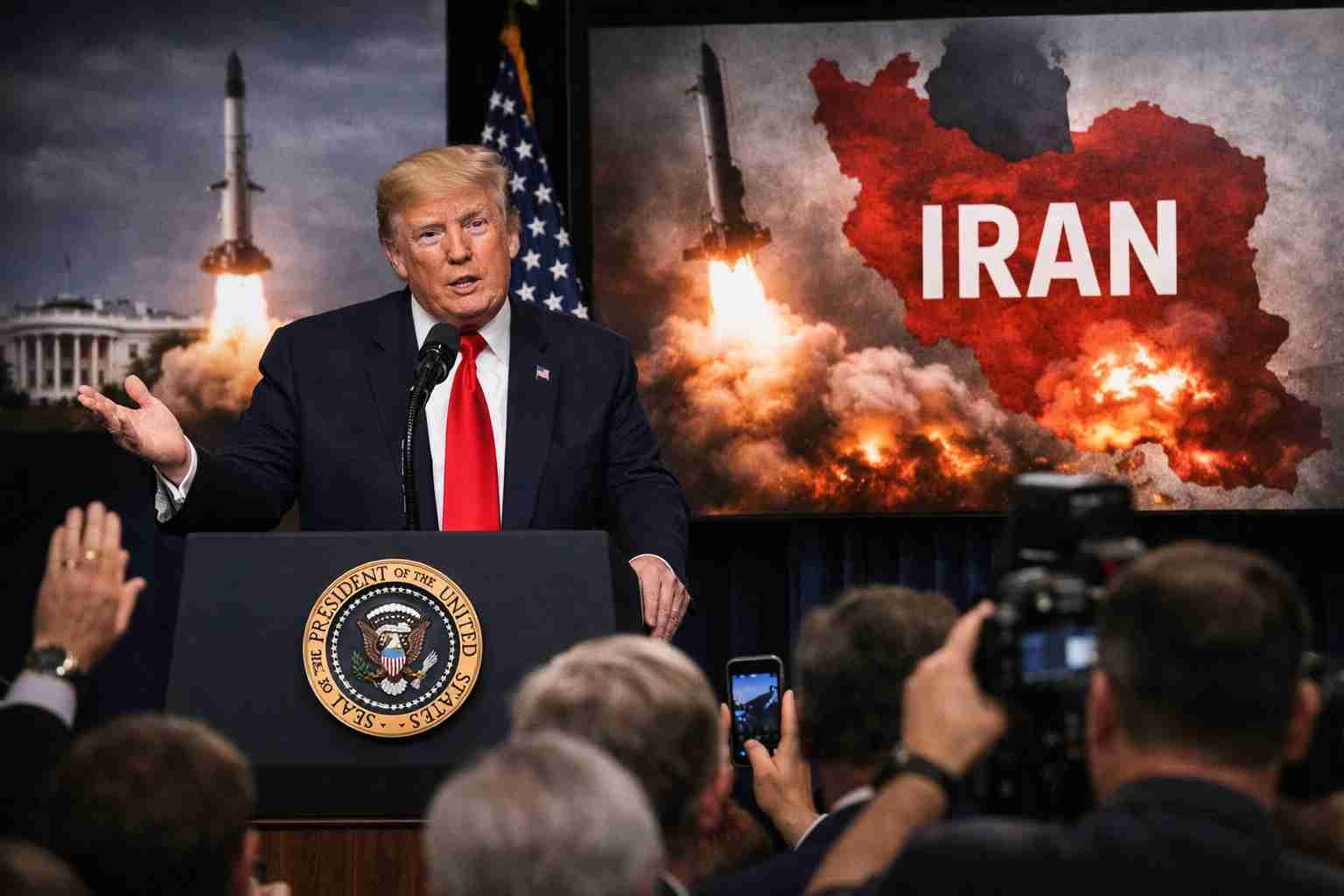
At a moment of heightened global tension, US President Donald Trump offered a confusing and at times contradictory assessment of the ongoing US military campaign against Iran. Speaking on Monday as oil prices surged past $100 a barrel and fears of wider conflict in the Middle East intensified, Trump attempted to reassure allies and financial markets that Washington had a clear strategy. Instead, his remarks raised new questions about the direction and objectives of the largest US military intervention in the region in years.
A War Described as Both “Won” and Just Beginning
Appearing in Doral, Florida, Trump delivered a 35-minute press conference intended to calm markets and reassure Middle Eastern partners worried about regional instability. However, the president avoided outlining a clear timeline or strategic end goal for the US operation in Iran.
Trump emphasized the damage inflicted on Iran’s military capabilities, portraying the campaign as highly successful. Yet his description of the conflict’s status appeared inconsistent.
In a phone conversation earlier with CBS News, Trump suggested the war was “very complete, pretty much.” When asked during the press conference whether that meant the conflict could end within days, he avoided giving a direct answer.
“No, but soon. I think soon. Very soon,” he said.
When reporters pointed out the apparent contradiction between Trump’s comments and his defense secretary’s statement that the campaign was “just the beginning,” the president replied that both interpretations could be true.
“I think you could say both,” Trump said, adding moments later that the effort marked “the beginning of building a new country.”
The remark raised eyebrows among analysts and lawmakers, particularly because the Trump administration had previously ruled out any long-term nation-building project in Iran.
Pressure From Oil Markets and Regional Allies
Trump’s comments came as global energy markets reacted sharply to the conflict. Oil prices remained above $100 per barrel for much of Monday, reflecting concerns that escalating tensions in the Middle East could disrupt supplies from one of the world’s most critical energy-producing regions.
Several US allies in the region have warned that the conflict could spiral into a broader regional confrontation involving multiple states or armed groups.
Against that backdrop, the president’s appearance appeared aimed at projecting confidence and stability. Instead, his remarks left observers uncertain about whether Washington intends to wind down operations or expand them.
“We could call it a tremendous success right now or we could go further,” Trump said. “And we’re going to go further.”
During an earlier speech to Republican supporters, he offered another ambiguous assessment: “We have won in many ways, but we haven’t won enough.”
Sharp Criticism From Democrats
Democratic lawmakers quickly criticized the president’s remarks, arguing that the administration lacked a coherent strategy.
Senate Democratic leader Chuck Schumer of New York described the press conference as deeply troubling.
“One word to sum up Trump’s press conference: clueless,” Schumer wrote. “He can’t articulate a plan or a vision because he has no plan or vision. He can’t even decide whether or not the country is at war. He’s risking the world economy and the lives of millions on whims and vibes.”
The criticism highlights growing political pressure in Washington as the conflict continues without clearly defined objectives or a publicly stated exit strategy.
Confusion Over Sanctions and Oil Policy
Trump also signaled a potential shift in US economic policy during the press conference. He suggested that Washington might temporarily relax sanctions affecting certain countries’ oil sales in order to stabilize global markets.
Such a move would represent a reversal of earlier efforts by the administration to increase pressure on Russian oil exports in connection with the war in Ukraine.
The president hinted that some sanctions might not be reinstated once markets stabilize.
“Who knows,” he said. “Maybe we won’t have to put them on. There will be so much peace.”
Controversial Claim About Missile Strike
One of the most striking moments of the press conference came when Trump suggested that Iran had somehow obtained a US-made Tomahawk missile and used it to attack a girls’ school in the southern city of Minab.
The strike reportedly killed more than 168 people, most of them children.
When asked whether the United States bore any responsibility for the incident — which occurred shortly before US forces struck a nearby Iranian naval base — Trump dismissed the possibility.
“Tomahawks are used by many countries,” he said, adding that “Iran has some Tomahawks.”
Several reporters challenged the claim, noting that no other US official had made a similar assertion.
“You’re the only person in your government saying this,” one journalist told the president.
Trump responded that the matter was still under investigation.
“I just don’t know enough about it,” he said. “I think it’s something that I was told is under investigation.”
Uncertainty Clouds the Path Forward
Trump’s remarks underscore the uncertainty surrounding the US campaign in Iran and the broader geopolitical consequences for the Middle East and global energy markets. With conflicting statements about whether the war is nearing its end or entering a new phase, Washington’s long-term objectives remain unclear.
As the conflict continues to evolve, both allies and adversaries are watching closely for signs of a coherent strategy from the White House — something that Monday’s press conference failed to provide.