

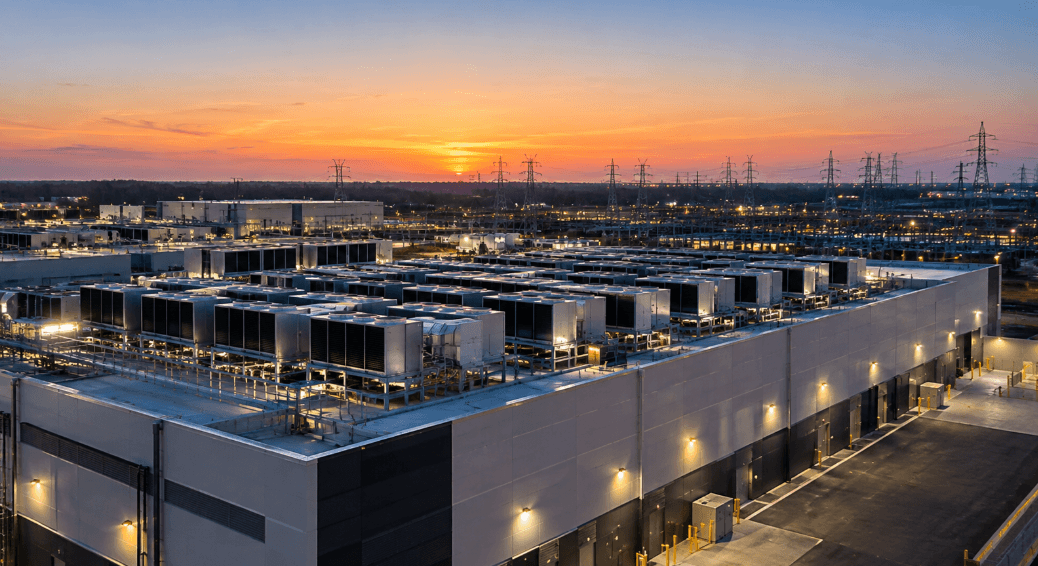
The rapid expansion of artificial intelligence is creating an infrastructure challenge that could become one of the biggest constraints on the technology’s growth. AI companies need enormous amounts of computing capacity and electricity, but the supply of data centers capable of supporting those workloads may struggle to keep pace.
While the AI industry faces several potential obstacles—including shortages of memory chips, higher borrowing costs and uncertainty over returns on massive technology investments—the availability of data-center capacity is emerging as a particularly immediate concern.
AI Growth Is Increasing Pressure on Data Centers
Artificial intelligence systems rely on large clusters of advanced processors housed inside specialized data centers. Training sophisticated AI models requires substantial computing power, while operating those models for millions of users creates additional, ongoing infrastructure demands.
As technology companies expand their AI services, demand for suitable facilities is rising quickly. Building new data centers, however, is far more complicated than simply purchasing additional servers.
Developers must secure land, electrical connections, cooling infrastructure, networking equipment and regulatory approvals. Large facilities can also require significant construction spending and lengthy development schedules.
The result is a widening challenge: AI computing demand can increase rapidly, but the physical infrastructure needed to support that demand takes considerably longer to build.
Electricity Supply Could Become a Major Bottleneck
Power Requirements Are Rising Alongside Computing Demand
Electricity represents another critical constraint.
Modern AI data centers can consume enormous amounts of power because thousands of high-performance processors may operate simultaneously. Those systems also generate substantial heat, requiring sophisticated cooling equipment that adds to overall electricity consumption.
In the United States, the issue is increasingly important for utilities and data-center developers as technology companies seek locations capable of supporting large new computing campuses.
Even when developers have the capital and equipment needed for a project, securing sufficient electricity can be difficult. New transmission infrastructure, substations and generation capacity can take years to develop.
That mismatch between the speed of AI investment and the slower pace of energy infrastructure development could restrict how quickly additional computing capacity becomes available.
AI Industry Faces Several Supply-Side Constraints
Data centers are not the only challenge confronting the industry.
AI servers depend heavily on specialized semiconductor components, including advanced processors and high-performance memory. Shortages or production constraints affecting those components can delay the deployment of new computing systems.
Financial conditions also matter. Data centers are expensive projects requiring substantial upfront investment. Higher interest rates can increase financing costs, particularly as companies and investors commit billions of dollars to new facilities.
At the same time, questions remain about the eventual return on AI spending. Technology companies are investing heavily in infrastructure while continuing to determine how quickly AI products can generate enough revenue and productivity gains to justify those expenditures.
These factors could influence the pace of expansion, but shortages of physical data-center space and available electricity may prove more immediate because they cannot be solved solely through additional spending.
Data Center Development Becomes Strategic Priority
The infrastructure race is pushing technology companies, utilities, developers and governments to reconsider how quickly new computing facilities and power supplies can be brought online.
Alternative sources of electricity and on-site generation technologies are receiving greater attention as operators search for ways to reduce dependence on already-constrained power grids. Energy efficiency is also becoming increasingly important as companies attempt to extract more computing performance from each unit of electricity.
Location decisions could become more strategic as well. Regions with available land, reliable electricity, strong fiber-optic networks and faster permitting processes may gain an advantage in attracting major AI infrastructure investments.
For communities hosting these projects, however, rapid data-center development can raise broader questions about electricity availability, grid investment, water consumption and local infrastructure.
Physical Infrastructure May Determine the Pace of AI Expansion
Artificial intelligence is often viewed primarily as a software and semiconductor story, but its continued expansion increasingly depends on physical infrastructure.
Advanced chips remain essential, and economic conditions could influence investment decisions. Yet even companies with access to processors and abundant capital need buildings, electricity, cooling systems and network connections before additional AI computing capacity can come online.
As AI adoption accelerates across the United States and globally, the ability to construct data centers and expand power infrastructure quickly enough may become one of the defining challenges facing the industry. The next phase of the AI boom could therefore depend as much on electricity grids and construction capacity as it does on advances in algorithms and chips.