

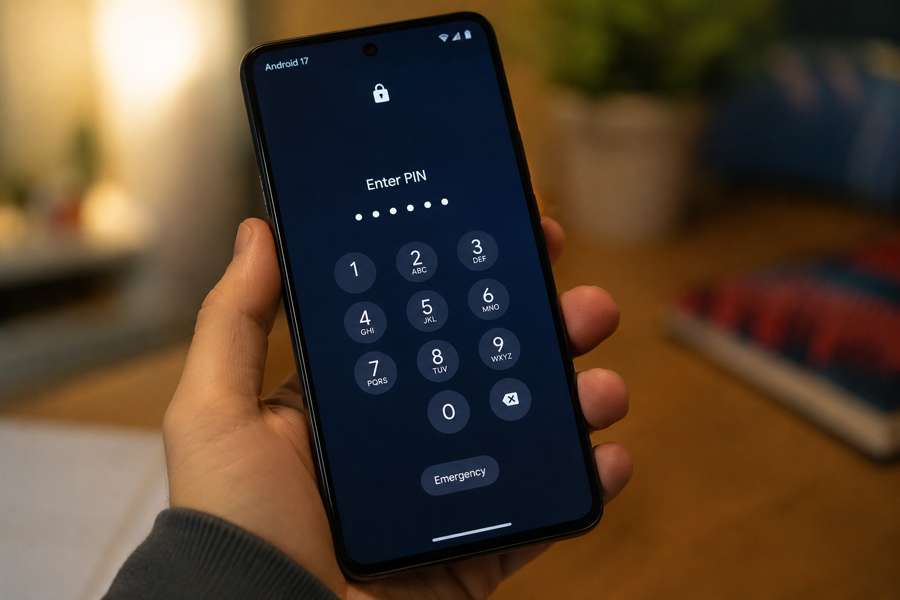
Google is significantly tightening smartphone security with Android 17, introducing stronger protections designed to prevent unauthorized users from gaining access through repeated PIN or password guesses. The update dramatically reduces the number of failed login attempts allowed over time, making it far more difficult for thieves or attackers to break into a device.
The new security measures were first announced during Google’s Android Show: I/O Edition in May. Additional details shared by Android expert Mishaal Rahman now reveal just how restrictive the updated protections will be.
Android 17 Cuts PIN Guess Attempts Dramatically
One of the most notable changes in Android 17 is a stricter rate-limiting system for lock screen PIN and password attempts on supported devices.
Under previous Android versions, users—or potential attackers—had considerably more opportunities to enter incorrect credentials before facing extended lockouts. Android 16, for example, permitted up to 10 attempts in the first minute, 20 within six minutes, 50 within 25 minutes, 110 over a 24-hour period, and as many as 1,800 attempts spread across five years.
Beginning with Android 16 QPR2 and continuing into Android 17, Google has adopted a much tougher policy.
Fewer Attempts Before Lockouts
Under the new limits, devices allow:
- Six attempts within the first minute
- Seven attempts within six minutes
- Eight attempts within 25 minutes
- Twelve attempts within 24 hours
- Nineteen attempts over a five-year period
After 20 incorrect PIN or password entries, the device will no longer accept additional guesses.
The change represents a dramatic reduction in allowable attempts, reflecting Google’s broader effort to strengthen mobile security as smartphones increasingly store sensitive personal, financial, and business information.
Why Google Is Tightening Lock Screen Protection
According to Google, the previous limits left room for attackers to exploit predictable user behavior. Many people continue to use common PIN combinations, birthdays, anniversaries, or other easily guessed numbers rather than randomly generated credentials.
In cases where an attacker has access to personal information—whether from social media profiles, public records, or other sources—the likelihood of successfully guessing a PIN can increase significantly.
By sharply reducing the number of permitted attempts, Android 17 aims to make brute-force attacks and targeted guessing strategies far less effective.
Added Protection Against Common PIN Choices
Security experts have long warned that weak PINs remain one of the most common vulnerabilities on smartphones. While modern devices include encryption and biometric authentication features, a simple numeric PIN can still become a point of weakness if it is easy to predict.
The new Android 17 restrictions are intended to provide stronger safeguards even when users choose less secure credentials.
Android 17 Includes an Exception for Legitimate Users
Recognizing that device owners sometimes forget their PINs or passwords, Google has introduced a safeguard designed to prevent accidental lockouts caused by repeated mistakes.
Android 17 features what Google calls a duplication exemption. If a user repeatedly enters the same incorrect PIN or password, those duplicate attempts will not count toward the failed-attempt limit.
Instead, the system identifies that the same incorrect credential is being entered multiple times and excludes those attempts from the running total. Users will also see a message explaining why the repeated entry was not counted.
This approach helps protect legitimate users who may be struggling to remember their credentials while maintaining strong defenses against attackers attempting multiple combinations.
A Major Security Upgrade for Android Users
The stricter lock screen protections in Android 17 represent one of the platform’s most aggressive security changes in recent years. By reducing allowable PIN and password guesses from 1,800 over five years to just 20, Google is making unauthorized access substantially more difficult.
While the tighter limits may require users to be more careful when entering credentials, the change strengthens protection against device theft, brute-force attacks, and unauthorized access attempts. As smartphones continue to serve as digital wallets, communication hubs, and repositories for personal information, stronger lock screen security is becoming an increasingly important part of mobile device protection.