

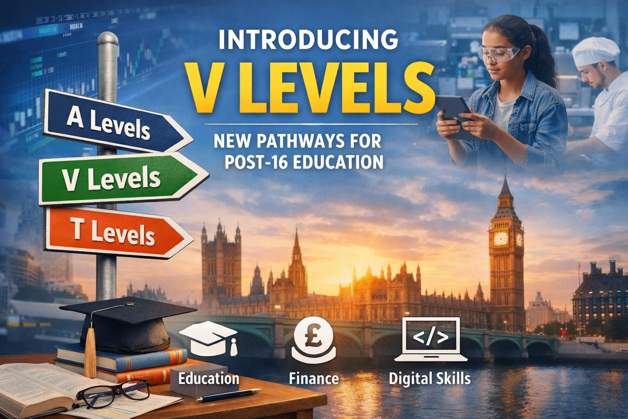
The UK government has unveiled the first subjects for its new V Level qualifications, marking a significant shift in post-16 education aimed at better aligning study with real-world careers. Beginning in 2027, students will be able to take V Levels in education, finance, and digital studies, part of a broader reform designed to help young people access well-paid jobs and address national skills shortages.
A New Qualification Alongside A Levels and T Levels
V Levels will sit alongside existing A Levels and T Levels within the UK’s secondary education system. Each V Level will be equivalent in size to a single A Level and will allow students to combine academic and vocational subjects if they are still deciding on a specialization.
The reform aims to address longstanding criticism that the education system has favored traditional academic routes while undervaluing technical and vocational pathways. By introducing V Levels, the government hopes to create more flexible learning routes tailored to employer demand.
The initiative is also part of the Prime Minister’s broader goal of ensuring that two-thirds of young people are in apprenticeships, higher training, or university by the age of 25. Policymakers believe the new structure will help reduce the number of young people who are not in education, employment, or training (NEET), while strengthening the UK workforce.
Expansion of T Levels and New Study Pathways
Alongside the introduction of V Levels, the government plans to expand T Levels, the technical qualification that combines classroom study with industry placements. New subject areas are expected to include:
- Sports, Fitness and Exercise Science
- Care Services
The reforms also introduce additional pathways designed to support students with different academic starting points.
Further Study Pathway
A new one-year preparatory programme will help students who are not yet ready to move directly into A Levels, T Levels, or V Levels. This pathway will lead to a Foundation Certificate qualification, providing extra academic preparation before progressing to higher-level study.
Occupational Pathway
A separate two-year employment-focused route will be available for students aiming to move directly into work or apprenticeships. Initial subjects will include:
- Catering and Hospitality
- Education and Early Years
This pathway will be supported by a new Occupational Certificate qualification designed to build practical workplace skills.
Survey Reveals Parent Concerns About Post-GCSE Options
The reforms come as new polling highlights uncertainty among parents about post-16 education choices.
A survey of more than 1,120 parents of teenagers aged 14 to 18 found that:
- 24% lack confidence that their child understands the options available after GCSEs.
- 45% prefer a combination of academic study and practical or technical training.
Officials argue that the redesigned qualification framework will provide clearer pathways and allow students to mix academic and vocational learning.
Government: Reform Will “End Snobbery” in Education
Education Secretary Bridget Phillipson described the reforms as a major step toward leveling the playing field between academic and technical education.
She said the changes would “end the snobbery in post-16 education,” giving students genuine choice and helping them build secure careers suited to the evolving job market.
The reforms were outlined in the government’s Post-16 Education and Skills White Paper, with consultation responses now published detailing how the new qualifications will be introduced.
Funding Boost for 16–19 Education
The government has backed the reforms with additional funding. Nearly £800 million in extra investment will be allocated to education for 16- to 19-year-olds in the 2026–27 academic year.
Average funding per student will rise to £6,874, up from £6,762 in 2025–26, providing additional support for schools and colleges implementing the new system.
Education leaders have largely welcomed the announcement. College groups say the reforms bring long-needed clarity to the qualification landscape, which has seen years of uncertainty over the future of technical and vocational courses.
Changes to Existing Qualifications
Under the new framework, the government plans to gradually phase out certain legacy Level 3 qualifications where T Levels already exist. This includes some BTEC courses and other qualifications roughly equivalent in size to two A Levels or smaller.
Instead, V Levels will be introduced in those subject areas, creating a simplified structure where most Level 3 study falls into one of three categories: A Levels, T Levels, or V Levels.
Regulator Ofqual will oversee the design and quality assurance of the new qualifications to ensure they are valued by universities, employers, schools, and colleges.
Preparing Students for the Jobs of the Future
Universities and industry groups have also expressed support for the initiative, noting that multiple pathways into higher education and employment are essential in a rapidly changing economy.
With the phased rollout beginning later this decade, policymakers hope the new qualification system will give young people clearer choices, stronger technical skills, and better preparation for future careers.
As the UK reshapes its post-16 education system, V Levels are intended to bridge the gap between academic study and practical training—offering students more flexible routes into university, apprenticeships, or the workplace.